Showing posts with label research assignment. Show all posts

Friday, 8 August 2008

Hybrid vehicle

In allience with past enteries, at the start of Project "Arms" development, I'd been told to keep it aligned with other classes to keep the workload down. So I thought I share a few pieces that come from my Drawing with contempoary techniques" class.
These drawings are based on the concept of combining a "no fine art" image/item and use it to create an artwork. Of course, how could I resist drawing hands. Excuse the blurry photos, nicer ones are coming.

Drawn on a photocopy of a list of longtitude/latitude of places, pencil and pen


Details


Photocopy of a technical drawing pasted onto A3 sheet, blue ballpoint pen


Detail:


Ink and water on paper, black ball point

This one needs more work, it's a start of something.


Project Arms2.0 - A discussion on changes in the project
Other Works" - Works that Project "Arms" reference
Project "Arms" - All about the Project
A Look - Retrospective on past drawings

Friday, 1 August 2008

Project "Arms"

The new art project will be tentatively called Project "Arms", which best describes what is going to be involved in it. I will go back to this entry as more thoughts and edits come.

The Concept
To create a series of drawings of human hands/arms, these limbs will be drawn without bodies, requiring the viewer to develop their own idea of what and why these arms are being presented. The concept behind by presenting these bodiless limbs is to determine if an emotional/physical connection can be made between the viewer and the artwork. As I outlined in the last entry:

"I've decided to return to this idea of an unknown human form and the concept/idea of an isolated human, maybe someone who is looking for recognition but who can not get it because they do not posses a full identity. I'm also playing with the idea of whether people can react to this unknown form despite not understanding fully who or what they may be doing."

I'm planning on having the arms being captured in the process of physical intimacy with other "bodies" or by themselves. I want the viewer to be like a I find with my life drawing that it has a voyeuristic quality about it, although there is a difference being naked and nude. When I'm drawing the model,I find I keep looking at them,for a first timer, it can be a daunting experience and you feel somewhat guilty for looking at them.

The concept behind these drawings does relate to sexual frustration and the sensation of touch. A singular person, for most people, always brings up associations of loneliness and longing. The main questions following are: Will people going to connect to it? Will the gestures lose their meaning because they are without their surroundings/bodies and if they do, will the gestures gain a different meaning.


Concept Development
Here are some development sketches, I originally just wanted to draw a picture and name it "Tiberus Rex". Don't ask why, I can't really explain but it was based on this image


Some sketches along the lines of the whole human bodies in postions of intimacy, trying to get something that would get a response but also carry the theme of longing, I don't know. Here you can see the body and hand was the most important thing.


I started planning this project sometime in the June/July holidays, I'm not quite sure what started it, though I think it may have been influenced by the previous life drawing class. In a life drawing class, you always have one model, so when you've finished drawing, there are a lot of isolated bodies. I think the last semester has given me enough confidence to decide to do this.

These are some drawings from the last semester done using charcoal and graphite on prepared paper. Even though there is more than one body, it's still a person/isolation in isolation.


Somewhere along the line, I started thinking about doing pictures of people in embrace, because that always get an emotive response. However it's quite in your face, people will get a connection but I thought, I'm likely going to get several kinds of reactions from my audience.
1. Awww (people who love romantic stuff)
2. Go for it (people who like a little action)
3. #@!! (people who aren't getting any)
4. Boring (people who are very honest)

The reaction of everyone except group 1 is very interesting, I get annoyed when people show me pictures of people kissing. I was thinking of closeups of hands touching faces and such. So I decided for a more subtle approach. It's a little like the Calvin Klein advertising, the kind of hidden desire in black and white. This also relates to a conversation I had with a friend who mentioned that in high school she learnt: The difference between art and porn is it's in black and white.

So it's a little like, the whole body compared to isolating the hands:


This came to my mind a few days ago, it comes from the webcomic Penny and Aggie by T. Campbell and Gisèle Lagacé. I think it's somewhat relevant.


Materials
So based on these:
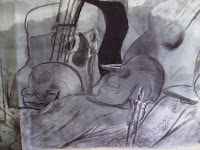

Project Arms will be on prepared paper that has watered down ink sponged onto it. The arms will be drawn using charcoal and white conte, although I'd like to use pencil, I don't want the pencil lines to show.

These are some mockups I did on the computer, although they're not perfect, they do illustrate the style I want these pictures to be in. I'll have to collect photo reference for this project, it'd be much better if I had a model but I'm limited to using photos.
I'm still deciding on what style of drawing to do these in,so feel free to comment.


InfluencesI've been thinking about this but I'm having a little trouble so here's a few artists who's work is in a similar vein to this project or who's work I think shares some attributes or who's work I'd like this project to be close to.

- David Choe
- Audrey Kawasaki
- Ray Caesar
- John John Jesse
- James Jean
- Chris Worfold <<-- This project probably owes a lot to Messiah Complex
- Del Kathryn Barton

Project Arms2.0 - A discussion on changes in the project
Other Works" - Works that Project "Arms" references
Project "Arms" hybrids - variants on Project Arms
A Look - Retrospective on past drawings

Thursday, 31 July 2008

art quack

I've been asked for a class to make blog posts about an upcoming art project that has to be completed this semester. So I have to record my thoughts, ideas and influences in a easy access medium. So I'm thinking of doing some pictures based on the techniques that I learnt from these pictures I did last semester.
This one is my favourite, it involves two pieces of paper,charcoal,white conte and a rag. The life model was wrapped up in calico,given a cow's skull and put on a chair. We drew what we wanted,every 30 mins we turned the model and chair around and drew what we say from the 'new view'.
Some details:


These are charcoal,graphite and white conte on ink stained paper and are based on the principal of vanitas


I've been asked to talk/write about the how and why of this upcoming project. So far I think it's a response and a return to my recent education in the human figure.

If you compare these two figure drawings, the top one from last year and the other from a few months ago.


From last year and part of this year, I've learnt I have decent observational skills but a lot of the time,when I do drawing outside a classroom situation, I don't have the same feeling as when I am in a studio. There's something about my class work that I do like and that isn't present in my non-class work.

Here be some observational sketches from last year:


Drawings from last semester:


Compared with these from last year:
This ones don't really feel as well produced as the others but while I was drawing them, I was trying to think outside: "this is a drawing of a person". Unfortunately I can't remember what I was thinking of at the time.


This next set somewhat reflects part of my (old?) approach to drawing the figure and of myself. None of these figures have faces, which is perhaps forcing them to become a bunch of bodies in motion.


With this new project (which will be explained in another entry) I've decided to return to this idea of an unknown human form and the concept/idea of an isolated human, maybe someone who is looking for recognition but who can not get it because they do not pocess a full identity. I'm also playing with the idea of wheter people can react to this unknown form despite not understanding fully who or what they may be doing.

More on these later.

Project Arms2.0 - A discussion on changes in the project
Influences - Project "Arms" influences
Project "Arms" hybrids - variants on Project Arms
Project "Arms" - All about the Project

Friday, 15 June 2007

A word

I was going though my digital art magazines when I came across this quote. "I paint my own reality. The only thing I know is that I paint because I need to,and I paint whatever passes through my head without any other consideration." Frida Kahlo

I'd really like to use that as a reason as to why I should not explain my art because sometimes I just really can't.

Monday, 11 June 2007

Painting Assignment - Development 2


More of how the painting came to be. This is a progression shot of the picture during my first lesson. I was aiming to get simular colours to the original painting here. As it turned out I had to make the background more interesting later on. I admit it looks pretty flat at this stage.


Adding in the towers,it really annoyed me that I didn't have very good brush control here,but I don't think I've gotten much better since then. I was aiming for some kind of lonely and mysterious place that was errected as something impressive or as a monument to someone. Incidently,the tower ended up looking like a lighthouse. So the picture looks more like a abanndoned sea that dried up eons ago. I did ditch the little shadows that were going to look like gateways. In my original sketch,it was a mysterious set of pillars and towers that had shadowy gates that lead to who knows where. I might do a version of that idea during the holiday.

Now for something vaguely different. I present a tower of another sort. You could go and make your own conclusions here but really I just saw it and said "It's tower-esqe in composition" and took a picture of it. I think the most disturbing thing is,it looks more forlorn than my painting.


This is more or less the final product,I am going to take a better picture of it by the end of the week. But now the tower has a lot better shadows and looks like it's expecting a light from above or falling stars. Go figure. I did learn a lot from painting this,but it seems I forgot most of it when I started my next one. I really don't know where this all ended up,I think I was heading towards a tower in an endless void and it turned into something else. Surprisingly it is somewhat impressionistic which I like.

Sunday, 10 June 2007

Towers

A few things about towers since the subject of the paintings are tower(s).
From http://en.wikipedia.org/wiki/Tower
Towers are tall man-made buildings, always (and usually much) taller than they are wide. Towers are generally built to take advantage of their height, and can stand alone or as part of a larger structure. Examples of the various uses of towers include:

* To save ground-level space: skyscrapers, cooling tower, chimney
* To enhance views: tourist towers, air-traffic Control tower, railroad yard tower, harbor control tower, filming tower
* To increase strategic advantage: prison watch tower, defensive walls, siege tower, fire lookout tower, camera tower
* To increase potential energy: storage silo, water tower, drilling tower, ski-jump ramp
* To enhance communications: radio mast, lighthouse, light tower, minaret, bell tower, clock tower, weather beacon
* As support: suspension bridge, cable-stayed bridge, pylon, aerial tramway support pillar
* To access tall or high objects: launch tower, service tower, supply tower, scaffold, tower wagon
* To access atmospheric conditions aloft: wind turbine, meteorological measurement tower, tower telescope, solar power station
* To protect from exposure: BREN Tower
* For industrial production: shot tower
* To drop objects: drop tower, bomb tower, diving platform
* To test height-intensive applications: elevator test tower
* To improve structural integrity: thyristor tower
* To mimic towers or provide height for training purposes: fire tower, parachute tower
* As art: Eiffel Tower, Shukhov Tower, Space Needle
* For recreation: rock climbing tower
* As a symbol: Tower of Babel, The Tower (Tarot card), church tower

Skyscrapers are often not classified as towers, although most have the same design and structure of towers. In the United Kingdom, tall domestic buildings are referred to as tower blocks. In the United States, the now-destroyed World Trade Center had the nickname the Twin Towers, a name shared with the Petronas Twin Towers in Kuala Lumpur.

Inccidently "The Tower" is a poem by William Butler Yeats which is a passionate indictment of a man wrestling with age. It can be read here.

Towers also relate to The Tower card.

________________________________________________________________________

This post is part of an art assignment to research a painting,document this research and produce an interpretation of said painting.

Monday, 7 May 2007

Giorgio de Chirico - The Nostalgia of the Infinite


The subject of the painting is a large tower. The scene is struck by low, angular evening light. In the foreground below the tower are two small shadowy figures reminiscent of those in future works by Salvador Dalí. This painting is the most famous example of the tower theme which appears in several of de Chirico’s works.

Though the painting is dated 1911, this date is generally held in question. It has been speculated by the Museum of Modern Art in New York that it was created from 1912 to 1913 while the Annenberg School for Communication suggests 1913-14.

Stealing from here again

________________________________________________________________________

This post is part of an art assignment to research a painting,document this research and produce an interpretation of said painting. Such is the power of the internet and the immediate quality of blogging.

Sunday, 6 May 2007

Giorgio de Chirico - Ariadne


This composition presents one of the artist's famous deserted public squares rendered in simple broad forms. Somber monolithic arches on the right cast a heavy geometric shadow filling two�thirds of the right foreground. On the left, seen slightly from above and in a vertical perspective, is the statue of the sleeping Ariadne. The background is sealed by a brick wall, beyond which rises a squat white tower. A distant train approaches from the left, a sailing ship from the right. The palette consists of ocher, deep brown, white, and green.

"Ariadne" is part of a series of five paintings, all of 1913, in which the statue of Ariadne plays a major iconographic role. This statue is a Roman copy of a lost Hellenistic sculpture of Ariadne asleep on the island of Naxos, where she had been abandoned by Theseus. The sculpture of Ariadne had great symbolic meaning for de Chirico, perhaps evoking the classical past to which he had been exposed during his childhood in Greece. In these works Ariadne is seen from various angles, horizontally, vertically, and in partial close-up. The most important paintings in the series are "Ariadne," "The Soothsayers Recompence" (1913; Philadelphia Museum of Art), and "The Silent Statue" (1913; formerly Jean Paulhan, Paris).

"Ariadne" is executed in the dry, thin manner that characterizes de Chirico's works of 1913�14. The artist created this composition, which belongs to his most elegiac early period, while living in Paris (1911�15). The "early" de Chirico, still a painter of simple and magical dreamlike pictures, as exemplified by "Ariadne," became one of the acknowledged predecessors of the Surrealists.

Courtesy of The Metropolitan Museum of Art

________________________________________________________________________

This post is part of an art assignment to research a painting,document this research and produce an interpretation of said painting. Such is the power of the internet and the immediate quality of blogging.

Giorgio de Chirico vs. The Aura of Credability!

Found while trawling the web,I can finally present some noteworthy research and abuse the Ctrl-C and V functions of my keyboard.

This post's sponser is Migraine Aura

More hilarity ensured if you click on above link!

The Italian painter Giorgio de Chirico is more and more appreciated as one of the emblematic figures of 20th century art. He has developed the style of "metaphysical art" and is seen as one of the forerunners of surrealism. Whereas current interpretations of his work by art historians and art critics focus on the literary and philosophical sources of de Chirico's poetics, e.g. the writings from Schopenhauer and Nietzsche, the British neurologist G.N. Fuller and the art historian M.V. Gale suggested, in a paper published as early as 1988 in the British Medical Journal, that migraine with aura may have acted as a basis for several unusual and recurrent features of his "Pittura metafisica".

Reconsidering the notion of de Chirico's migraine aura as source of his artistic inspiration, Ubaldo Nicola and Klaus Podoll have systematically examined his published works as painter and writer, including his "Memoirs", the semi-autobiographical novels "Hebdomeros" and "Mister Dudron" and his collected essays. References to migraine aura symptoms were identified according to phenomenal similarities not only with clinical descriptions of such phenomena as established in neurological semeiology, but also with the paintings and drawings from the Migraine Art collection which currently consists of 562 pieces.

The available documents provided unexpectedly rich evidence for a diagnosis of migraine with aura, as summarized in the monograph "The aura of Giorgio de Chirico - Migraine Art and Metaphysical Painting".


As an expansion of Fuller' and Gale's previously reported findings, it was possible to document familiarity, childhood onset and a wide range of symptoms of de Chirico's migraine with aura as described in his writings. Blanke and Landis (2003) objected that the available evidence suggests a diagnosis of temporal lobe epilepsy (TLE) rather than migraine, but major criticisms can be raised against their selection and interpretation of data (Podoll and Nicola, 2004) and according to the present author's opinion they failed to demonstrate convincing links between the assumed diagnosis of TLE and de Chirico's metaphysical painting (Blanke and Landis, 2004).


Giorgio de Chirico's revelation in Florence, 1909

"... let me recount how I had the revelation of a picture that I will show this year at the Salon d'Automne, entitled Enigma of an Autumn Afternoon. One clear autumnal afternoon I was sitting on a bench in the middle of the Piazza Santa Croce in Florence. It was of course not the first time I had seen this square. I had just come out of a long and painful intestinal illness [abdominal migraine], and I was in a nearly morbid state of sensitivity [hypersensitivity to light and noise; migraine aura phenomena]. The whole world, down to the marble of the buildings and the fountains, seemed to me to be convalescent. In the middle of the square rises a statue of Dante draped in a long cloak, holding his works clasped against his body, his laurel-crowned head bent thoughtfully earthward. The statue is in white marble, but time has given it a grey cast, very agreeable to the eye [photophobia]. The autumn sun, warm and unloving [photophobia; exposure to sun as trigger factor of migraine attack], lit the statue and the church façade. Then I had the strange impression that I was looking at all these things for the first time [jamais vu], and the composition of my picture came to my mind's eye. Now each time I look at this painting I again see that moment. Nevertheless the moment is an enigma to me, for it is inexplicable. And I like also to call the work which sprang from it an enigma."

A question on migraine headaches − Excerpts from a Usenet Newsgroups discussion

"I am curious to know where most surrealists stand on the use of drugs (both illegal and legal), and the sensations brought about by the loss of blood to the brain (the headache). Are these manipulations of the mind (brought about by outside forces and internal loss), plausible to categorize under the surrealist experience?"

(Brandon J. Freels, Newsgroups: alt.surrealism, Re: Question on Drugs and Headaches, October 20, 1998)

"yes."

(J. Michael, Newsgroups:alt.surrealism, Re: Question on Drugs and Headaches, October 20, 1998)

"Migraine Headaches have been claimed by some sufferers to induce a trance-like state during which they experience enhanced creativity. [...] I say, take your inspiration from wherever you can get it... its quicksilver glimmerings mayn't be stored for long, so you must warehouse as many inspirational inspirations as possible. Just be sure to have a lot of aspirin on hand..."

(elag, Newsgroups:alt.surrealism, Re: Question on Drugs and Headaches, October 20, 1998)

"The reason why I posted my question is due to my own contradictory views. On one hand I see the use of drugs as unsurreal, because you are experiencing the drug, and not yourself − but in cases of bodily transformations (headache, fever, etc) you are not experiencing yourself either, but the loss or gain of something into the body. But I also am wondering if one can not achieve the surrealist view by subsiding to what we consider today to be 'healthy,' or even a 'healthy mindset' therefore verifying the use of drugs, and any other effect on the body as a positive way to create the surrealist experience. So maybe now people understand my self induced confusion. It seems that the only surrealist experiences I have are based on some physical or mental trauma, and if this is so they why shouldn't the drug induced trauma be considered surrealist also? I simple don't know how to answer my own question."

(Brandon J. Freels, Newsgroups:alt.surrealism, Re: Question on Drugs and Headaches, October 21, 1998)


________________________________________________________________________

This post is part of an art assignment to research a painting,document this research and produce an interpretation of said painting. Such is the power of the internet and the immediate quality of blogging.

Giorgio de Chirico - Web crawling


Chirico developed his enigmatic vision in Munich and Italy and from 1911 to 1915 he worked and exhibited in Paris. His powerful, disturbing paintings employ steep perspective, mannequin figures, empty space, and forms used out of context to create an atmosphere of mystery and loneliness. His work exercised a considerable influence on early surrealist painters but was never successfully imitated. In Ferrara, Chirico developed what he termed metaphysical painting, in which he consciously exploited the symbolism of his art. Chirico is represented in leading galleries throughout the world.

Forcibly kidnapped from Fact Monster

Giorgio de Chirico (July 10, 1888 - November 20, 1978) was an Italian painter born in Volos, Greece founded the scuola metafisica art movement. After studying art in Athens and Florence, de Chirico moved to Germany in 1906 and entered the Academy of Fine Arts in Munich, where he read the writings of the philosophers Nietzsche and Arthur Schopenhauer and studied the works of Arnold Bocklin and Max Klinger. After 1910 he lived in Italy.

De Chirico is best known for the paintings he produced between 1909 and 1919, his Metaphysical period, which are memorable for the haunted, brooding moods evoked by their images. At the start of this period, his subjects were still cityscapes inspired by the bright daylight of Mediterranean cities, but gradually he turned his attention to studies of cluttered storerooms, sometimes inhabited by mannequins.

He won praise for his work almost immediately from the writer Guillaume Apollinaire, who helped to introduce his work to the later Surrealists. Yves Tanguy wrote how one day in 1922 he saw one of de Chirico's paintings in an art dealer's window, and was so impressed by it he resolved on the spot to become an artist -- although he had never even held a brush! Other artists who acknowledged de Chirico's influence include Max Ernst, Salvador Dali, and Rene Magritte. De Chirico strongly influenced the Surrealist movement.

Later in his life De Chirico abandoned the metaphysical style and started painting more realistically, but with much less success.

De Chirico also published a novel in 1925: Hebdomeros, the Metaphysician. His later paintings never received the same critical praise as did those from his metaphysical period.

Borrowed Giogiro de Chirico ART CENTRE


After studying art in Athens and Florence, de Chirico moved to Germany in 1906 and entered the Academy of Fine Arts in Munich, where he read the writings of the philosophers Nietzsche and Arthur Schopenhauer, and studied the works of Arnold Böcklin and Max Klinger.

He returned to Italy in the summer of 1909 and spent six months in Milan. At the beginning of 1910 he moved to Florence where he painted the first of his 'Metaphysical Town Square' series: The Enigma of an Autumn Afternoon after the revelation he felt in Piazza Santa Croce. He also painted The Enigma of the Oracle while in Florence. In July 1911 he spent a few days in Turin on his way to Paris. De Chirico was profoundly moved by what he called the 'metaphysical aspect' of Turin: the architecture of its archways and piazzas. It was the city of Nietzsche. De Chirico moved to Paris in July 1911, where he joined his brother Andrea. Through his brother he met Pierre Laprade a member of the jury at the Salon d’Automne, where he exhibitted three of his works Enigma of the Oracle, Enigma of an Afternoon and Self-Portrait. During 1913 he exhibited his work at the Salon des Indépendants and Salon d’Automne, his work was noticed by Pablo Picasso and Guillaume Apollinaire, he also sold his first painting, The Red Tower. In 1914 through Guillaume Apollianaire, he met the art dealer Paul Guillame, who he signs a contract with for his artistic output.

At the outbreak of the First World War, he decided to return to Italy, arriving in May 1915 when he enlisted in the Italian army. He was considered unfit for work and assigned to the hospital at Ferra. He continued to paint, and in 1918, he transfered to Rome. From 1918 his work was exhibited extensively in Europe. He met and married his first wife, the Russian Ballerina Raissa Gurievich in 1924, and together they moved to Paris. In 1928 he held his first exhibition in New York and shortly afterwards, London.

In 1930 De Chirico met his second wife, Isabella Pakszwer Far, a Russian, with whom he would remain for the rest of his life. Together they moved to Italy in 1932, finally settling in Rome in 1944.

De Chirico is best known for the paintings he produced between 1909 and 1919, his metaphysical period, which are memorable for the haunted, brooding moods evoked by their images. At the start of this period, his subjects were still cityscapes inspired by the bright daylight of Mediterranean cities, but gradually he turned his attention to studies of cluttered storerooms, sometimes inhabited by mannequin-like hybrid figures. Later in his life De Chirico abandoned the metaphysical style and started painting more realistically. His later paintings never received the same critical praise as did those from his metaphysical period.

De Chirico also published a novel in 1925: Hebdomeros, the Metaphysician. His brother, Andrea de Chirico, who became famous as Alberto Savinio, was also a writer and a painter.

Stolen and abused from Wikipedia


Major Italian painter, who founded the metaphysical school. He was born in Volos, Greece, the son of an Italian engineer. He studied art in Athens and in Munich, where he was strongly influenced by the allegorical works of the 19th-century Swiss painter Arnold B�cklin. In Turin and Florence and in Paris, where he settled in 1911, he painted deserted cityscapes, such as Enigma of an Autumn Night (1910) and Mystery and Melancholy of a Street (1914). These early metaphysical works, through sharp contrasts of light and shadow and exaggerated perspective, evoke a haunting, ominous dream world. As an army conscript in Ferrara in 1915 de Chirico met the futurist painter Carlo Carr�; together they founded the magazine Pittura Metafisica in 1920. From 1915 to 1925 de Chirico painted bizarre, faceless mannequins and juxtaposed wildly unrelated objects in his still lifes, a technique adopted by the surrealists. From 1924 to 1930 de Chirico gave enormous impetus to the surrealist movement and influenced such surrealists as Yves Tanguy and Salvador Dal�. By the mid-1930s he had turned to an outworn academic style and chose to become a fashionable portraitist.

As taken from this site here

Another 1 page site about de Chirico

A timeline of de Chirico's life

APdf From the The Philadelphia Museum of Art Also a HTML Google web crawler version

de Chirico Officale website In Italian

________________________________________________________________________

This post is part of an art assignment to research a painting,document this research and produce an interpretation of said painting. Such is the power of the internet and the immediate quality of blogging.

In the Beginning

In the Beginning, The Nostalgia of the Infinite caught my eye. I was already in a relationship with Vase with Fifteen sunflowers so it seemed unfaithful to be looking at someone else. If anyone was too blame it was Dali's fault. I had been researching him approximately 3 weeks before hand and had finally come to some point where I actually understood Surrealism. I could also blame this which had lead me done to this work.

I don't know why it was this game as I have never played it before. It was a random encounter on my usual walk on the net. Despite the size of it,I never venture far enough. Wikipedia seems to part of my safety net.

I only found out this week,Giorgio de Chirico is considered a starting point or an influence for Surrealistic art.

I'm not sure what drew me to this picture,I remember feeling that my substitute painting teacher would tell me that I was picking something too easy. Every one's seen Van Gogh countless times. Of course it never occurred to me at the time that I could choose anything I felt like.

Though it did occur to me that painting sunflowers was difficult and that I still had yet to decide on a way to reinterpret the painting. I blame it on the fact that Ico was on my mind. Perhaps it was the apparent simplicity of it all that convinced me to do it. My eye is always drawn to buildings I don't know why. But buildings as a man-made structure are always easier to remodel than something that has occurred naturally.

And so half an hour later,I was holding both paintings in my hand,trying to decide which one to go for. It later became a split second decision based on the teacher mentioning that The Starry Night should not be appearing in the class,because there is always someone who wants to work it to death. Perhaps not in those words but that is what memory is for. It embellishes.

3 hours later and I had finished making a copy of The Nostalgia of the Infinite. Although I missed painting in the flags,I was quite happy with it. It wasn't a pure copy,but it did give me an excellent view of the composition. Before I started painting it,it was just a strange picture of a tower.

And now I can see the infinite space that was/is occupied within this painting.


________________________________________________________________________

Originally conceived in my head somewhere near the 20th of April.
This post is part of an art assignment to research a painting,document this research and produce an interpretation of said painting. Such is the power of the internet and the immediate quality of blogging.